Emotional Intelligence the Context for Successful Nursing Leadership a Literature Review
Nurse Managers' Emotional Intelligence and Effective Leadership: A Review of the Current Evidence
Panagiotis E Prezerakos*
Laboratory of Integrated Health Intendance, Nursing Department, University of Peloponnese Eastward & St. Valioti and Plateon Str., 23100, Sparta, Hellenic republic
Article Information

Article History:
Received Engagement: 26/1/2018
Revision Received Engagement: 21/3/2018
Acceptance Date: 7/5/2018
Electronic publication engagement: 31/05/2018
Collection yr: 2018
Article Metrics
CrossRef Citations:
14
Unique Statistics:
Total-Text HTML Views: 7458
Abstruse HTML Views: 953
PDF Downloads: 1032
ePub Downloads: 301
Total Views/Downloads: 9744

© 2018 Panagiotis E Prezerakos.
open-access license: This is an open access commodity distributed under the terms of the Creative Commons Attribution 4.0 International Public License (CC-By four.0), a copy of which is available at: https://creativecommons.org/licenses/past/iv.0/legalcode. This license permits unrestricted use, distribution, and reproduction in whatever medium, provided the original author and source are credited.
Background:
Emotional Intelligence has made a significant contribution to effective leadership, condign 1 of the key characteristics of leaders.
Objective: The aim of the nowadays written report was to review qualitative and quantitative studies apropos Emotional Intelligence of nurse leaders and the evidence-based composition of their results.
Method:
A search was performed in the electronic databases (Pubmed, Scopus and CINAHL) for articles, which were published in the catamenia 2000-2017 in English or Greek. 11 studies met the inclusion criteria, of which ten were quantitative and one was qualitative.
Results:
The results suggested that Emotional Intelligence is a useful tool for nurse leaders and contributes decisively to the achievement of effective direction in healthcare.
Conclusion:
It is necessary for nurses to amend their social and emotional skills because of the particular nature of the nursing profession, which places the good for you or weak person at its center.
Keywords: : Emotional Intelligence, Leadership, Nurses, Nurse managers, Nurse leaders, Calcium.
i. BACKGROUND
"Emotional Intelligence: Why It Can Matter More than Than IQ" was the title of Goleman's book [1] which fabricated the concept of Emotional Intelligence (EI) widely known and contributed significantly to the expansion of inquiry in this field. Salovey& Mayer [2] ascertain EI every bit, "the subset of social intelligence that involves the ability to monitor one'southward ain and others' feelings and emotions, to discriminate amongst them and to utilize this information to guide one's thinking and actions". Emotionally intelligent individuals are able to use, understand and manage their feelings in a way that benefits themselves and others [3]. Studies conducted with children, adolescents and adults highlight the beneficial result of EI on the happiness of the individual [4], emotional command [5], decision making [6], job satisfaction [seven], occupational commitment [8] and Human being Resources Management [nine].
Recent theories emphasize that effective leadership is affected past the personality of the leader, the general conditions in the workplace and the quality characteristics of employees [10].More than specifically, Skinner and Spurgeon [xi] annotation that health leadership involves understanding and communicating with a wide variety of individuals in a number of different situations and not just focusing on work results and rational processes. From this perspective, the fact that the EI has made a significant contribution to effective leadership becomes one of the key characteristics of leaders. Equally Cummings and his colleagues [12] support, emotionally intelligent nurses with an administrative position inspire emotions, passion and motivation helping thus to achieve goals that might otherwise have not been conquered.
The aim of the present study was to systematically review qualitative and quantitative studies concerning EI of nurse leaders and the evidence-based composition of their results. In particular, it was attempted to highlight the reasons why EI is of import for achieving effective nursing leadership
2. MATERIALS AND METHODS
A search was performed in the electronic databases (Pubmed, Scopus and CINAHL) for articles, which were published in the period 2000-2017 in English or Greek. The literature review was carried out from September to October 2017. The keywords used were: Emotional Intelligence, Leadership, and Nursing. The inclusion criteria that were applied included (a) the publication date had to be betwixt 2000 and 2017, (b) the languages were Greek or English language, (c) both qualitative and quantitative studies were included, and (d) the sample of studies reviewed included only nurses. In order to achieve a final listing of related studies, a broad literature search was conducted to place abstracts that met the inclusion criteria. The titles and abstracts were printed, duplicates were discarded and the remaining abstracts were examined using the inclusion/exclusion criteria (Fig. one ).
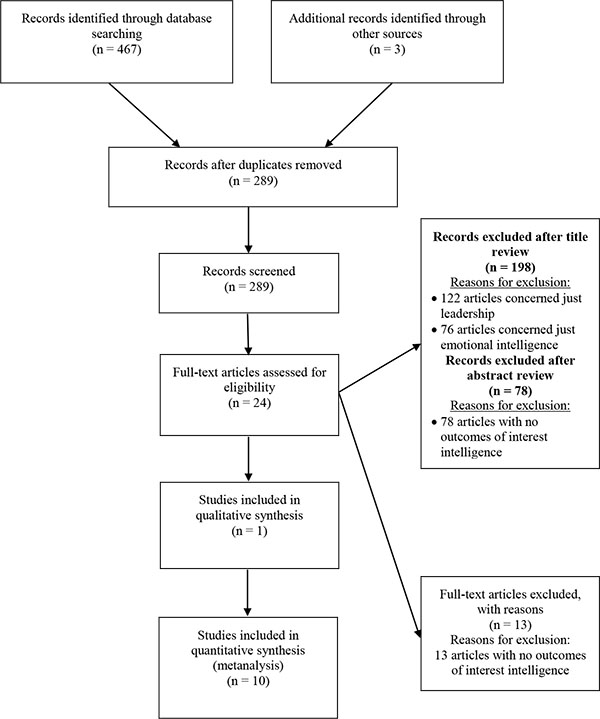 | Fig. (1). The entire sample was then critically analyzed in order to outline the reasons why EI is of import for achieving effective nursing leadership in the health sector. |
3. RESULTS
The literature review included 470 articles. Of these, 300 abstracts were evaluated by the writer with regard to their compatibility with the inclusion criteria in the analysis (Flowchart). Finally, eleven (11) studies met the inclusion criteria Tabular array 1 , of which seven (7) were conducted in the United states of america of America [13-19], one (1) in Turkey [20], one (i) in Australia [22] and i (1) in Canada [23]. But i (1) of the selected studies was qualitative [22], in which the researchers used focus groups to investigate the research question. In the remaining studies [13-21, 23] data drove was carried out using structured questionnaires. With regard to the sampling method, just two studies [xx, 23] were randomly sampled.
Table i. An overview of studies' characteristics, aims and chief findings
| Authors (Year of Publication) | Title Type of Research -Number of participants) | Country | Aim | Results |
|---|---|---|---|---|
| Spano-Szekely, Griffin, Clavelle, Fitzpatrick, (2016) [17] | Emotional Intelligence and Transformational Leadership (TL) in Nurse Managers (Cross-sectional, quantitative, 148 nurse managers) | Usa | To make up one's mind the relationship between EI and TL in frontline acute care NMs. | EI was significantly positively correlated with TL and outcome measures of extra-effort, effectiveness, and satisfaction and significantly negatively correlated with laissez-faire leadership |
| Tyczkowski et al., (2015) [18] | Emotional Intelligence (EI) and Nursing Leadership Styles Amid Nurse Managers (Cross-sectional, quantitative, 142 nurse managers) | USA | To examine the relationships among educational activity, leadership experience, emotional intelligence and transformational leadership of nurse managers. | Statistically significant positive relationships were noted between EI and transformational leadership and the outcomes of leadership (extra attempt, effectiveness, and satisfaction). No statistically significant relationships were noted betwixt EI and transactional or laissez-faire leadership styles. |
| Leggat & Balding, (2013) [22] | Achieving organizational competence for clinical leadership: The role of high performance piece of work systems (Qualitative, 28 clinicians and clinician managers) | Australia | To present the results of a qualitative written report with clinicians and clinician managers to gather opinions on the advisable content of an educational initiative being planned to ameliorate clinical leadership in quality and safety among medical, nursing and allied health professionals working in chief, community and secondary intendance. | But four individual factors, comprising emotional intelligence, resilience, self-awareness and agreement of other clinical disciplines, were identified as being important for clinical leaders. |
| Lucas, Spence- Laschinger & Wong, (2008) [23] | The impact of emotional intelligent leadership on staff nurse empowerment: the moderating effect of bridge of control (Cross-sectional, quantitative, 230 nurses) | Canada | To test a model linking nurses perceptions of their nurse manager s emotionally intelligent leadership fashion and nurses structural empowerment, and the impact of nurse manager span of control (number of directly reports) on the emotional intelligence/empowerment relations | Span of control was a significant moderator of the relationship betwixt nurses' perceptions of their managers' emotionally intelligent behavior and feelings of workplace empowerment. |
| Moss, Ritossa, & Ngu, (2006) [19] | The consequence of follower regulatory focus and extraversion on leadership behavior: The function of emotional intelligence. (Cross-sectional, quantitative, 66 pairs of nurses and their supervisors) | United states of america | Emotional intelligence should heighten the chapters of managers to adapt their leadership way. | Emotional intelligence might enhance the capacity of managers to adjust their leadership style accordingly, but only in some contexts |
| Spagnuolo et al., (2014) [21] | Emotional Leadership: a survey on the emotional skills expressed past nursing management (Cross-exclusive, quantitative, 130 managers, head nurses and nurses) | Italy | This study investigates knowledge about the emotional leadership and emotional competence in nursing direction. | It is essential for managerial roles, be aware and able to manage their own and others' emotions to generate wellbeing at work. |
| Ohlson & Anderson, (2014) [13] | Ability emotional intelligence of nurse managers in the Midwestern United states of america (Cross-sectional, quantitative, 87 nurse managers) | USA | To draw the emotional intelligence (EI) and examine the corresponding demographic characteristics of front-line Nurse Managers in astute care settings | What is interesting is the pregnant difference in EI between nurses who are certified in whatsoever specialty versus those who are not certified at all. |
| Echevarria, Patterson & Krouse, (2016) [14] | Predictors of transformational leadership of nurse managers (Cantankerous-sectional, quantitative, 148 nurse managers) | USA | To examine the relationships among teaching, leadership experience, emotional intelligence and transformational leadership of nurse managers. | Statistically pregnant relationship was found between emotional intelligence and transformational leadership (r = 0.59, P < 0.001) explaining 34% variance in transformational leadership. |
| Erkutlu &Chafra, (2012) [20] | The impact of team empowerment on proactivity The moderating roles of leader's emotional intelligence and proactive personality (Cantankerous-sectional, quantitative, 910 certified nurses in 82 teams from 12 university hospitals) | Turkey | To investigate the relationship between team empowerment and team proactivity and the moderating roles of a squad leader'due south emotional intelligence (EI) and a squad fellow member'south proactive personality | Proactivity is positively associated with team empowerment. In improver, team leader'due south EI and squad members' proactive personality influence the relationship between squad empowerment and team proactivity. Specifically, teams exhibit the highest proactivity when team leaders' EI and squad members' proactive personality are high. |
| Prufeta, (2017) [15] | Emotional Intelligence of Nurse Managers (Cross-exclusive, quantitative, 38 nurse managers) | United states of america | To determine the level of emotional intelligence (EI) among nurse managers (NMs) in an academic medical center and make up one's mind the relationship of EI and demographic variables. | Mean EI scores among NMs were boilerplate. Nurse managers with less than 2 years of experience had statistically significant lower busing emotions branch score and strategic EI. Nurse managers with a master's_ degree in nursing scored significantly college in using emotions branch score than did those with a principal's caste in a related field. |
| Munro, (2011) [xvi] | Nurse Managing director Emotional Intelligence as a Predictor to Registered Nurse Chore Satisfaction and RN Perceptions of the Practice Environment and the Relationship to Patient, Nursing and Hospital Outcomes (Cross-sectional, quantitative, 38 nurse managers & 659 RNs) | The states | To investigate if the level of Nurse Managing director (NM) emotional intelligence (EI) predicted registered nurse (RN) job satisfaction and RN perceptions of the practice environment. | NM EI was significantly correlate and patient satisfaction with nursing intendance. |
Three of the eleven studies included in the review explored the leadership style applied past emotionally intelligent nurses holding an authoritative position [fourteen, 17, xviii]. The critical analysis of their results revealed the positive correlation between the Emotional Inelegance and the transformational leadership in which the leader works with subordinates to increase their motivation and promote their delivery to the organization [24]. In two studies [17, 18], in that location was a statistically significant positive correlation of the EI with the outcome of the leadership on the actress effort, effectiveness and satisfaction of EI, Spano-Szekely and her colleagues [17] underline the negative relationship between the EI and the laissez-faire leadership, in the class of which, according to Harms and Credé [25], leaders are avoiding decision making, are reluctant to take action and their function is typical. In contrast, in the study conducted by Tyczkowski and her associates [18], the above negative relationship is not confirmed. Furthermore, no significant correlation observed between EI and transactional leadership styles [18].
Erkutlu and Chafra'southward [xx] study, on a sample of 910 nurses, revealed that high nurse leaders' EI have a strong positive impact on the pro-action and empowerment of the squad [23]. The results of Munro'southward study [16] pointed out that the high EI of nurses performing authoritative tasks is associated with increased patient satisfaction with the care provided. In addition, EI along with resilience, cocky-awareness and agreement of other clinical disciplines were revealed equally important qualifications for nurse managers. Moreover, emotionally intelligent leadership, through the skills of proficient emotional management, promotes well-existence at the workplace [21]. Regarding the relationship of EI and demographic characteristics, information technology was noticed that nurses, who exercised administrative duties and had not received any specialization, showed modest emotional intelligence in contrast to their colleagues, who were specialized [xiii]. In addition, nurses, who held a mail service-graduate degree in nursing science, had enhanced their skills in the proper employ of emotions, compared to nurses who had specialized in another field [15]. Every bit important was the experience in direction positions, as managers with less than ii years of experience experienced the less successful apply of their feelings than those with longer seniority in management positions [15].
4. DISCUSSION
The results of this written report suggest that EI is a useful tool for nurse leaders and contributes decisively to the achievement of effective management in healthcare. The nature of the nursing profession itself, aimed at health promotion, disease prevention and care of physically and mentally sick and disabled people of any age [26], requires nurses to be emotionally intelligent in order to respond to their multifarious duties. The anthropocentric nature of nursing requires Emotional Intelligence as a high-level skill that contributes to effective patient centered intendance [27]. More specifically, with regard to the practice of direction functions, EI becomes an important "virtue" in the hands of nurse-leaders who must exist equipped with skills to successfully meet the growing demands of the modernistic health care system. Management skills, such equally negotiating resource, building trust relationships, encouraging partnership development, and making show-based decisions, require a strong foundation of perceiving, using, understanding and managing feelings [13]. Analysis of a number of the studies selected [xiv, 17, 18] revealed that EI was associated with the practise of the transformational leadership. According to Bass and Avolio [28] transformational leadership refers to the idealized influence that the leader exercises on his/her subordinates, the feeling of pride which he/she inculcates likewise every bit the feeling of safety and confidence that they can cope with the arrangement's goals and vision. The high ability to sympathise, regulate and manage emotions that transformational leaders have, contributes decisively to the tillage of respective skills in their followers [29]. EI's potent association with transformational leadership is not present simply in the wellness sector only also in a diverseness of other organizations [xxx-33]. Barling, Slater and Kelloway's study [34], which deals with a big lurid and paper manufacture, revealed a positive correlation between the EI and the three aspects of transformational leadership: idealized influence, inspirational motivation, and individualized consideration. Similarly, in Sivanathan and Fekken's [35] study, in the university community, established that loftier levels of emotional intelligence were associated with transformational leadership model. Furthermore, the same analysis revealed that the emotionally intelligent management "triggers» proactivity [20], the team empowerment [twenty, 23], patient satisfaction of care provided [16], wellbeing at work [21] and contributes decisively to pay extra effort on the part of subordinates, efficiency and chore satisfaction [17, 18]. Developed emotional skills of leaders and followers, are instrumental in achieving a healthy work environs, not only in the healthcare field but also in ministries, public services, security bodies, private companies, industries, schools, reinforce organizational commitment [36-39], chore satisfaction [36-38, 40, 41] and wellbeing in the workplace [38].
Conclusion
EI is of import for achieving effective leadership in healthcare organizations and contributes decisively to their practiced-functioning and successful functioning. Individuals have the ability to identify and feel a wide range of emotions in everyday life. All the same, some of them are not able to utilize, understand and manage these emotions. That fact suggests that information technology is necessary to improve their social and emotional skills. Every bit regards nurses, at every level, the above need is considered imperative because of the particular nature of the nursing profession, which places the healthy or weak person at its center. Past implementing social and emotional learning programs, nurses can learn noesis, attitudes and skills that are necessary for understanding and managing emotions, achieving positive goals, and maintaining positive relations and accountable decisions.
LIST OF ABBREVIATION
| EI | = Emotional Intelligence |
CONSENT FOR PUBLICATION
Not applicable.
CONFLICT OF INTEREST
The writer declares no conflict of interest, financial or otherwise.
ACKNOWLEDGEMENTS
Declared none
Source: https://opennursingjournal.com/VOLUME/12/PAGE/86/
0 Response to "Emotional Intelligence the Context for Successful Nursing Leadership a Literature Review"
Post a Comment